
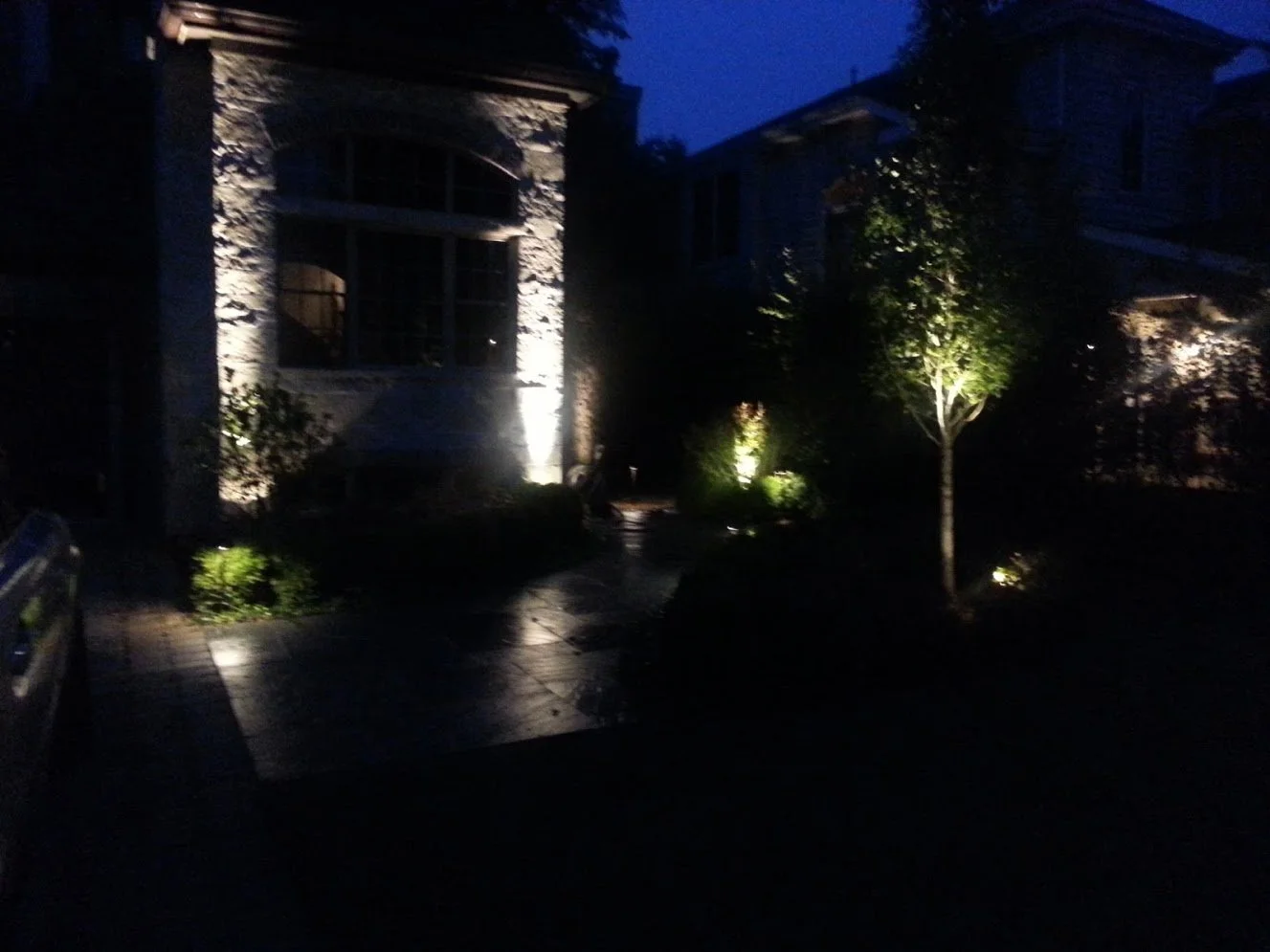
At eight o’clock on a July evening, a property shows an outdoor lighting company in Northbrook, IL things a daytime walkthrough cannot. The house reads as a flat silhouette. The planting beds disappear completely. The eye travels to the brightest object in view, which is often a bare bulb over a side door or a neighbor’s garage fixture sitting just past the property line.
Joe and Tony Landscaping is a family-owned and operated business bringing decades of hands-on experience to properties across the North Shore, and lighting is where that experience pays off after sundown. A plan drawn in daylight is a prediction about contrast. Darkness is the only condition in which that prediction can be checked.
This guide covers what a lighting design is actually solving, how fixture placement and beam choice decide the result, what glare does to an otherwise good scheme, and why the final positions get set on site at night.
Related: Designing the Perfect Backyard: 10 Outdoor Kitchen and Outdoor Lighting Ideas for Vernon Hills, IL
What Is an Outdoor Lighting Plan Actually Solving?
An outdoor lighting plan solves four problems: orientation, depth, hierarchy and safety, and none of them is a shortage of fixtures. Orientation comes first: a visitor arriving after dark should understand without thinking where to park, where the path starts and which door is the front one.
The second is depth. An unlit garden ends at the window glass, so a room that looks out onto black reflects its own interior back at the occupants. Putting modest light at the far edge of a yard pushes that boundary outward and makes the property feel considerably larger from inside.
The third is hierarchy. Not everything deserves the same brightness, and a scheme that lights every object equally reads as a parking lot. The specimen tree, the stone chimney mass and the front entry are the things worth seeing; the utility meter and the downspouts are not.
The fourth is safety, which a good plan handles quietly. Steps, grade changes and the edges of a drive need to be legible underfoot without a row of bright fixtures announcing each one.
Where Does the Eye Go First in a Lit Landscape?
The eye goes to the brightest point in the field of view, every time, and that is the single most useful rule in lighting design. Control of a night scene is really control over where the brightest point sits.
This is why a scheme can fail with good fixtures correctly installed. If a path light near the driveway is the brightest thing on the property, a guest looks at the path light rather than at the house, and the architecture the owner paid to illuminate recedes behind it.
The correction is usually subtraction rather than addition. Lowering the output near the viewer, or moving a fixture further from the approach, restores the intended order without adding a single new light.
Why Are Dark Gaps Part of a Lighting Design?
Dark gaps give a lit landscape its shape, because continuous illumination flattens a property. The contrast between a lit tree canopy and the darkness around it is what defines the canopy, and removing the dark removes the effect.
Deliberate gaps also give the eye somewhere to rest, which matters on a long approach. A rhythm of lit and unlit stretches along a drive reads as considered, while an unbroken line of fixtures at even spacing reads as municipal.
What Causes Glare in Landscape Lighting, and Why Does It Ruin a Scheme?
Glare is caused by a visible lamp in nearly every case. It happens when the source itself enters the line of sight rather than the surface it is meant to light, and the eye adapts to that bright point by giving up everything dimmer around it.
Aiming angle is the usual culprit. An uplight set too far from a tree trunk throws its beam across the sightline of anyone walking toward it, so the fixture is seen instead of the tree. Moving it closer and steepening the angle fixes the problem without changing the lamp.
Shielding handles the rest. Hoods, glare guards and recessed lenses keep the source hidden while letting the beam through, and on fixtures near a patio or a window they are the difference between comfort and squinting.
Seating position decides which fixtures need that treatment. A light that is invisible from the walk can sit directly in view of someone sitting on the terrace, so the scheme gets checked from where people actually sit rather than only from where they walk.
How Is Beam Spread Chosen for Landscape Lighting?
Beam spread is chosen by the size and distance of the thing being lit, which is a measurement rather than a preference. A narrow beam concentrates output into a tight column, and a wide beam spreads the same output across a broader surface at lower intensity.
A tall columnar evergreen wants a narrow spread that carries up the full height. A broad spreading maple over a lawn wants a wider spread, often from two or three positions, so the canopy fills rather than showing a single bright stripe up the trunk.
Masonry is its own case. Grazing a stone wall from close range at a shallow angle rakes across the surface and brings out the texture, while lighting the same wall from further back flattens it into a pale panel.
Color temperature belongs in the same decision. A warmer tone flatters brick, stone and timber and keeps a house looking like a home, while cooler output tends to make warm materials look gray and green foliage look artificial.
Why Is Lighting Output Easier to Reduce Than to Add?
Lighting output is easier to reduce than to add because adjustable fixtures and lower-output lamps give a scheme somewhere to go in both directions. Specifying slightly more capability than a surface needs and then dialing it back is the practical approach.
A property lit at full output on day one has only one remedy available when the result feels harsh, which is pulling fixtures out. Starting with restraint and adding where the night walk proves a gap keeps the decision reversible.
Where Should Landscape Lighting Fixtures Sit?
Landscape lighting fixtures belong out of sight during the day and out of the mower’s path at all times. A fixture set in the middle of a bed that will be mulched each spring gets buried, and one placed at the edge of a lawn gets clipped, so position accounts for maintenance as much as for optics.
Planting growth is the longer problem. A shrub that sits comfortably behind a fixture at installation can swallow it within three seasons, and the symptom is a scheme that quietly dims year by year while nobody can say what changed.
Path lighting deserves particular restraint. Fixtures set at close, even intervals along both sides create a runway, while staggered positions at wider spacing light the same walk with roughly half the hardware and a far better result.
Lighting positions hold up longer when they are coordinated with the planting plan rather than added afterward. Our landscape design work accounts for mature spread, so a fixture has room to keep working as the bed fills in.
How Should the Arrival Sequence to a House Be Lit?
The arrival sequence should be lit in order, at descending brightness from the street to the door. A car turning off the road needs to find the drive, so the entrance takes the first and strongest cue, often a pair of lit piers or a specimen tree standing at the mouth of the drive.
The walk between the parking area and the door is the second stage, and it wants less light than people expect. Once the eye has adapted to darkness a modest fixture reads clearly, and overlighting the walk makes the house behind it look dim by comparison.
The door itself is the destination and should resolve the sequence. A lit entry surround, a legible house number and a step edge that can be read underfoot finish the arrival without a floodlight over the garage competing for attention.
Timing ties it together. An astronomic timer that tracks sunset keeps the arrival lighting honest through the year without anyone resetting a clock, and a later shutoff on the garden zones lets the approach stay lit after the rear of the property goes dark.

Why Is an Outdoor Lighting Design Settled on Site at Night?
An outdoor lighting design is settled on site at night because contrast cannot be calculated from a plan drawing with any confidence. Ambient light varies enormously between properties: a house near a lit street needs more output to register, while a wooded lot on a dark lane needs markedly less.
Reflectance varies just as much. Pale limestone returns a great deal of light and needs a modest lamp, while dark brick or stained cedar absorbs most of what reaches it and needs considerably more for the same apparent brightness.
So the final step is a night demonstration. Fixtures are positioned temporarily, powered up and viewed from the places that matter: the end of the drive, the front walk, the terrace and the windows of the rooms used in the evening.
Adjustments at that stage cost nothing. Moving a fixture eighteen inches, swapping a lamp for a narrower beam or taking one out altogether takes a moment before the wire is buried and the beds are closed.
What Should a Landscape Lighting System Allow For Later?
A landscape lighting system should allow for added capacity and easy access, both of which are decided at installation. A transformer sized exactly to the original fixture count leaves no headroom, and the first addition then means replacing the transformer rather than adding a lamp.
Zoning is the other provision worth making early. Separating the entry and drive from the garden and terrace lets the approach run every evening while the rear of the property is switched on for use, which saves energy and lamp hours.
Low-voltage systems make this manageable. We install low-voltage lighting with timed and dimmer-setting controls, and because the cable runs at low voltage the circuit can be extended later without the trenching depth a line-voltage system demands.
Access to the connections matters just as much. Splices and junctions placed where they can be reached keep a fault to a ten-minute repair, while connections buried under a finished terrace turn the same fault into excavation.
How Does a Landscape Lighting Scheme Change Through the Seasons?
A landscape lighting scheme changes considerably through the seasons, and a plan built only around August foliage disappoints for much of the year. A deciduous canopy that fills the frame in summer becomes an open structure of branches by November, and the fixture lighting it is suddenly throwing most of its output at the sky.
Evergreens and built elements carry the winter scheme for that reason. Stone piers, the house facade, a pergola structure and conifers hold their form in every month, so they take the weight when the deciduous planting thins out.
Early darkness changes the usage pattern too. In a Chicago-area December the lights are the property for most of the hours anyone is home, which raises the value of getting the entry sequence and the view from the main rooms right.
Snow is the seasonal variable people forget. Fresh cover reflects a great deal of light and brightens a scheme substantially, while drifted snow can bury ground-level fixtures entirely, so mounting height gets chosen with February in mind.
What Does Outdoor Lighting Ask of the Rest of the Property?
Outdoor lighting asks the rest of the property for surfaces worth looking at. Light reveals whatever it lands on, which means a beautifully lit scheme over tired paving simply makes the paving easier to see, and the fix is masonry rather than optics.
Edges read especially hard at night. A bed line that looks acceptable in daylight shows every wobble when raked by a low beam, so crisp edging and sound joints matter more on a lit property than an unlit one.
Our patios, walkways and retaining walls get detailed with that in mind, because the surfaces are what the scheme ultimately displays. Our landscape lighting design and installation is specified alongside them rather than treated as a later accessory.
Planting condition shows as clearly as masonry does. A beam raking across a bed with gaps in it advertises the gaps, so a lighting scheme and a planting refresh are frequently worth scheduling together rather than a season apart.
Choosing an Outdoor Lighting Company in Northbrook, IL That Designs After Dark
A lighting design is a set of decisions about contrast, and contrast can only be judged in the dark, on the property, from the places people stand and sit. The right sequence is to arrive at dusk, set temporary fixtures, look at the house from the end of the drive and adjust before anything is buried.
Joe and Tony Landscaping approaches outdoor lighting company work in Northbrook, IL with the finished night view in mind, and an evening walk of the property is where that starts.
Schedule your outdoor lighting consultation with Joe and Tony Landscaping.
In Summary
Can outdoor lighting be added to a landscape that is already planted?
Outdoor lighting can be added to an established landscape with little disturbance to mature planting or finished paving. Low-voltage cable is set at a shallow depth and routed through bed lines rather than across lawn, so the existing landscape usually stays intact. The work that takes care is routing around established root systems, which is done by hand near significant trees.
Will the fixtures need adjusting after the first year?
Fixtures typically need one re-aiming visit after the first full season. Planting grows into beams, frost can shift a fixture slightly out of aim, and the first full winter shows which positions were set around summer foliage. Joe and Tony Landscaping recommends a short re-aiming visit after a season to keep the scheme performing as designed.
How long does a lighting installation take on an established Northbrook property?
The cable and fixture work on a typical residential property runs one to three days, depending on the length of the runs and how much hand digging the trees require. The night demonstration and final aiming is a separate evening visit, since those positions can only be judged after dark.
Related: A Quick Guide on Outdoor Lighting Options Offered in the Buffalo Grove, IL Area
